
On Humanoid Robots
Against the humanoid: why they limit the future they promise.

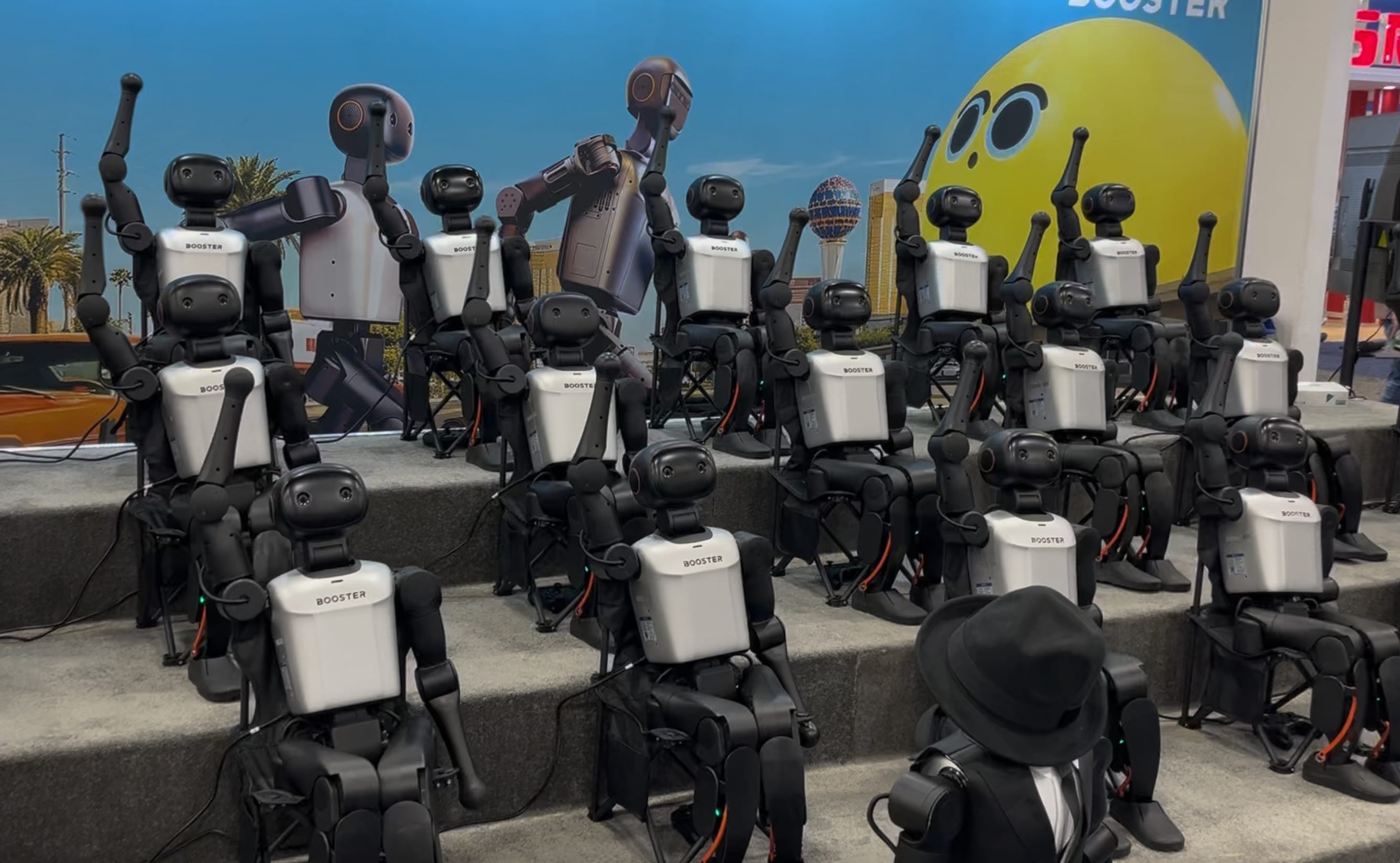
I am for the most part bored by humanoid robots. I find this confusing, as many of my peers in both engineering and design seem in a constant state of excitement about them. Humanoid embodiments seem to me, uncreative at best, nostalgic or narcissistic at worst. Regardless, we see more and more humanoids and the hype about them doesn’t seem to relent. As a part of ruminating on ‘what is professionally wrong with me’ (a deep well, to be sure) it seems worthwhile to attempt to unpack this boredom and perhaps latent frustration.
Some of this may be owing to a systems engineering background. Having been close enough to how the sausage is made makes these embodiments feel less inevitable and more like a choice. I made enough soccer playing robots with 68000s in the 90s to have a sense of both the complexity and the relative possibilities in contemporary sensing, machine vision, motion systems, combined with untethered computational power. It is all very technically impressive but the possibilities for embodiments are manifold.
The big developments in the field seem to come in waves, and each successive wave brings with it renewed excitement and enthusiasm, but at a high enough level it seems like we are presented and re-presented with some version of the same thing: a human-ish electro-mechanical structure that awkwardly navigates a conference floor, attempts the odd hand-shake, and executes some pre-choreographed dance number. It’s great stuff, but I am always left wondering to what end?
The arguments I hear defending this approach can generally be reduced to one of the following three, in order of least convincing to most:
The human form is the optimal embodiment for existence on earth
It is the ideal and most natural interface for human interaction
It provides “reverse human compatibility” and can be neatly slotted into a role previously occupied by a human
My ambition here is only to examine these arguments, and perhaps posit some others or acknowledge other influences that may be at play.
1. The human form is evolution’s solution for “general purpose agent”. Any sufficiently advanced robotic system will naturally converge on the same form.
This is the engineer’s argument. It neatly sidesteps the question of what possibilities exist by framing further development around the template in hand. Why revisit questions that evolution has already answered?
This works on a superficial level and is sufficient for winning an argument at the bar as it neatly shuts down the position that we might just lack imagination. Evolution is a powerful optimizer, and it converged on ‘human’ as the definitive form for an autonomous agent operating in our environment. Any advanced system should naturally arrive at the same form, not out of imitation but out of necessity.
It bakes in a few critical assumptions and struggles under closer examination. The position that evolution is optimal, perfect, and yields only ideal solutions is doing a lot of work. Our bodies carry with them inefficiencies and historical baggage that relate to where and how we evolved. We have eyes in the front of our head because predator-prey dynamics on the savanna rewarded it. We have two legs as a result of having adapted from a system which previously used four limbs for locomotion. Our hands are a kind of compromise between a structure that worked well both for climbing and for tool use. The majority of our sensing equipment is positioned adjacent to our processing hardware in an oddly fragile and exposed location. None of this is ideal, and better resembles a series of patches on historical architecture overdue a good refactoring than it does a thoughtfully designed system. So while it is true that evolution is a powerful optimizer, it optimizes iteratively for reproductive success within an ecological niche, not for mechanical efficiency or for coherent system design.
Further, nature itself hasn’t repeated this particular thread in the interest of optimization. Some bodies are streamlined for swimming, wings are very specifically adapted for flight. Bipedalism paired with general intelligence seems to have emerged only the once which makes weak evidence that it is universal. Rather, when autonomous intelligence does show up elsewhere in nature it takes on very different forms. The octopus is a good example.
So, among the arguments we have for giving robots humanoid form, this one doesn’t appear sufficient.
2. Humanoid robots are not imitation, they just provide the best possible human-machine interface.
This one is more interesting and might come from someone considering human-machine interactions. It shifts the burden of optimization away from the robot itself over to the human perceiver. Communication is hard enough between humans, so why mess with the system?
Our sensitivity to the subtle expressions in each other is well documented. We are fundamentally a herd animal, and as a result have finely adapted abilities to read body language, posture, inflection, and other signals in the interest of building trust, fostering belonging, detecting or communicating danger. This approach would seem rich territory and is an intuitive choice as a foundation for building an interface.
Exploring this has led to some excellent work in the field over the last 30 years, but at its root lies an assumption that what has worked well for interaction between humans (human to human) would map neatly to human machine interfaces. Why would that be true? Humans interact with each other on the basis of a shared foundational humanness. Machines are not human, so setting a machine to try to emulate human-ness results in a distorted version of human interaction rather than embracing its machine nature and interacting in a way that acknowledges the divide.
Pushed to its extreme, we bump into the familiar and charismatic problem of uncanny valley. As robotic systems converge on human we like them more, until they get close enough that we find them revulsive. If that is the case, then the argument that narrowing the gap in interaction between human and machine by emulating humans is the best approach seems to self-refute.
This argument is better than the first. Still, trying to design using human social signals directly will create a system that is naturally measured against humans themselves, and will always fall short. Doing this risks building towards a simulacrum rather than a new or authentic relationship that is appropriate with a machine. Uncanny valley is a kind of tax that we pay for taking this approach.
So it seems there may be value in exploring this territory, but not being so literal about it. We might learn from the way we interact with each other to gain insight into how we would like to be interacted with, but cannot paste our own behaviours onto a machine and expect good results.
3. A Robot with a human form can occupy any space, use any tool, and fill any role that was designed for the human body.
This is the reverse-human compatibility argument and the most difficult to dismiss. In our time on the planet we have accumulated an enormous amount of infrastructure and tools, all of which is designed around some statistical model of a human. If we are to introduce a robot to our world, this is the lowest friction way to do it. Everything from a cockpit to an operating theatre, drills to surgical tools, are already in production and widely available in the world. Not only could a machine use these things immediately if it were designed to emulate us, but it would spare enormous effort in redesign, fabrication, supply chain, regulatory pathways and so on to fit some new conception of how a device would perform a task in a particular space. As such, the humanoid form isn’t sentimental or an aesthetic choice, but rather a very practical shortcut. We’re designing for the world that we have, not trying to re-design the world to some new conception of how this device could be.
On the surface, this is a great argument for our dancing humanoid friends. We can continue living in the world that we built and smoothly introduce these things to live alongside us. But if we design machines only to inherit our existing infrastructure, we are committing to that infrastructure as the only available possibility. This approach presents as futuristic and pragmatic but is instead conservative and limiting.
If we’re designing these devices to fit and work within our world as it is, then we’re avoiding a more interesting question of “how might the world be”. We’re casting robots into our own frame, and making them conform to the world we have created for ourselves rather than asking not only how might a robot be if we shed the human paradigm, but also which environment might they occupy? This argument limits any future worlds with robots in them to those that we already occupy which is awfully boring. For if we perfectly fit a robot to our existing world, we have less incentive to reconsider that world.
If we applied this approach to technological development through history we would have some strange results. Transportation would still be horse-based since the infrastructure for horses already existed. Ocean going transport might just involve more sails rather than what we have. Transitional technologies reuse infrastructure where it is appropriate but are not shy about abandoning the earlier form. Early trains didn’t maintain a horse form to signal equivalence or leverage their tack. Humanoid robotics is strange in that it preserves human morphology when the underlying mechanics have radically diverged. Transformative technologies shape the world and our perceptions of it rather than remaining bound to what already exists. This is wildly inefficient but inescapable.
So, while this argument is the best of the bunch, the humanoid approach to robotics should be transient at best; an approach we adopt as we transition from our own world to one in which our space is shared with and partially shaped by robotic systems.
There are certainly other reasons why we see this phenomenon, like a need to appeal to and convince shareholders, generate media attention, appeal to a particular nostalgic account of the future. While all may contribute, they are not as convincing as the three arguments above.
I don’t intend for this piece to be an end state. There is excellent work, contemporary and historical, commercial and academic, that probes and challenges the assumption that somehow a humanoid form is ideal. Science fiction is also worth visiting, as those futures are less encumbered by physics, history, supply chains, technical constraints, and our existing world, so the proposed embodiments have been more free and are interesting to consider. In later pieces I hope to explore some of those ideas through the same lens and eventually develop a framework for exploration in this area that is less constrained.
An approach to commercial robotics in which we cast robots into our own frame and confine them to the world we already live in seems to limit our thinking, not only about the form these technologies might take, but also what worlds they may form or inhabit. Freeing autonomous robotic systems from a human form might yield different machines, but also different environments, and with them perhaps different conceptions of agency.